Kristen Foxen (born Kristen Bicknell) has mastered the world’s most exclusive final tables. With five World Series of Poker (WSOP) bracelets to her name and live tournament earnings exceeding $9.4 million, she has become a definitive benchmark in the industry. However, Kristen’s story is a testament to how discipline, family environment, and early passion can converge to create a high-performance professional player. In this article, we will explore Kristen Foxen’s childhood and adolescence.
St. Catharines
Kristen Dawn Bicknell was born December 29, 1986, in St. Catharines, Ontario, Canada, near the U.S. border. Away from Las Vegas’s glitz, Kristen grew up in a competitive, high-achieving environment. She didn’t just follow rules; she observed, seeking the logic behind games and social dynamics. Her family provided her with emotional security, supporting her risk-taking in a male-dominated industry. Her parents valued both academics and sports, fueling her career’s core traits.
Kristen’s father, Pete Bicknell, is a legendary Canadian racing driver whose name is immortalized in the Canadian Motor Sports Hall of Fame. Kristen grew up in a home where dedication, precision, and the relentless pursuit of victory were daily values. Although Kristen did not follow in her father’s footsteps on the track, the “high-performance” competitor mentality appears to be a family inheritance. It is also worth noting that Kristen had two older sisters. In any family dynamic, this encourages a spirit of resilience and the ability to interact and stand one’s ground—qualities that would prove highly useful at aggressive, mostly “masculine” professional poker tables.
A childhood of games and strategy
During her early school years, Kristen already showed an inclination toward board games and any activity requiring concentrated mental effort. Unlike other children who saw play as a distraction, for her, it was an opportunity to gauge her skills. It wasn’t about an obsession with winning, but rather a genuine pleasure in the problem-solving process. In the St. Catharines school environment, she stood out as a diligent student with an independent streak. Her teachers remembered her ability to focus for long periods, a skill that would later become her greatest asset at the poker tables, where mental fatigue is a constant that can affect a player’s performance. This stage of Kristen’s life was fundamental in shaping her patience; she learned that results are not always immediate and that consistency is the most powerful tool for overcoming daily obstacles.
First contact with poker
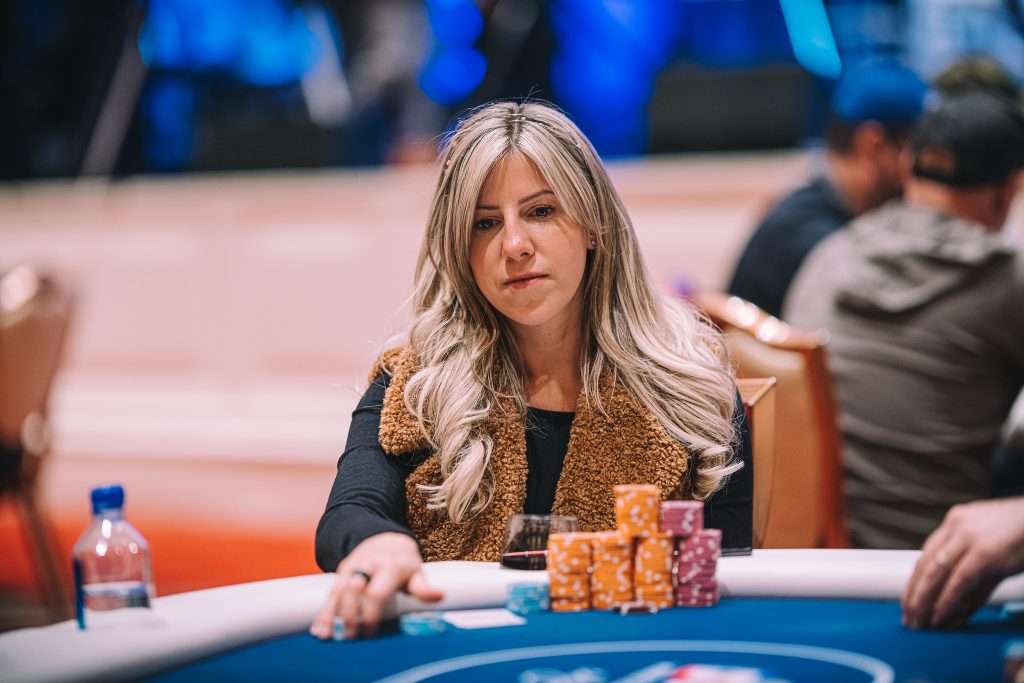
For Kristen, the spark for poker didn’t arrive until she entered university. It was during her freshman year at Carleton University in Ottawa, where she studied Criminology, that fellow students taught her the basic rules of the game. Kristen began playing casual games with friends, and what was a simple Saturday-night pastime for many became a revelation for her. She quickly identified that poker was not a game of chance, but a game of people and mathematics—a world she found very easy to connect with. This transition from adolescence to adulthood was marked by long nights of self-taught study. Kristen began playing online under the pseudonyms “krissyb24” on PokerStars and “krissy24” on Full Tilt Poker, names that would soon command respect in virtual rooms. Her initial approach was extremely cautious, as she wasn’t seeking quick glory but rather an understanding of the game’s mechanics. This stage was her true “master’s degree,” where she sacrificed the typical outings of someone her age for hours in front of the screen, analyzing hands, ranges, and probabilities.
What began as a social and recreational activity soon ignited a competitive flame. She was drawn not just to the game itself, but to the intellectual challenge and the possibility of applying rigorous logic to outplay her opponents. However, before those motivations and commitments fully grew, there was a crucial element that sowed the seeds of ambition and showed her a possible path: television.
Jennifer Harman on “Poker After Dark”
One of Kristen’s favorite shows was “Poker After Dark,” featuring player Jennifer Harman. Harman served as a role model for Kristen, primarily because she was one of the few women competing on equal terms with male professional players at the high-stakes tables. Jennifer Harman didn’t just play; she did so with a composure and respect that commanded admiration. She represented the possibility of breaking barriers in a male-dominated field. For Kristen, seeing Jennifer Harman in action was more than entertainment—it was a revelation. It made her feel that she, too, could aspire to that level of success and respect. This early inspiration served as a beacon, providing clear direction for her burgeoning interest. Even before she had played a serious hand, she already had a model of who she wanted to become.
The Rise of the “Ultimate Grinder”
As her career progressed, Kristen dubbed herself the “Ultimate Grinder.” Between 2011 and 2013, while her career was emerging, she achieved Supernova Elite status on PokerStars—a milestone that required playing 2.5 million hands per year at stakes from $1/$2 to $2/$4. By the time she won her first WSOP bracelet in 2013, Kristen Foxen was no longer just a “prospect”; she was a seasoned player who would serve as a role model for future generations of female poker players.
What do you think about this topic? Do you know any other details about Kristen Foxen?
If you want to find the best poker deals, you can contact us by visiting the following link.
Image by World Poker Tour via flickr.com under Creative Commons license.