Johnny Moss, known worldwide as “The Grand Old Man of Poker,” did not merely serve as a historical figure in the gambling world; he laid the foundation for modern professional poker. Moss embodied the transition of poker from dangerous underground games in oil fields to the international prestige of the World Series of Poker (WSOP). He defined his legacy by demonstrating technical skill unmatched for his time, legendary physical and mental endurance, and a trophy case that features 8 WSOP titles (though tradition references his 8 physical bracelets and his inaugural trophy), placing him among the all-time greats. In this article, you will learn more about Johnny Moss and his WSOP bracelets.
The early days of a Texas “Rounder”
Johnny Moss was born on May 14, 1907, in the small town of Marshall, Texas. His childhood was marked by adversity from a very early age. At the age of eight, he lost his mother, and his father, who worked as a deputy sheriff, suffered a work accident that left him crippled when a telephone pole fell on his leg. This family tragedy forced young Johnny to drop out of elementary school to help support the household, selling newspapers for a penny apiece on the streets of Dallas, where the family had settled.
While working, his attention was not on ordinary passersby but on those who seemed to thrive in a world of poverty, such as the gamblers playing dice in the alleys, the domino experts at the Ackard Street saloon, and, above all, the poker players at the Otter’s Club. It was in this environment that, at just 16, he found his first opportunity. The owner of the Otter’s Club offered him three dollars a day to act as a lookout, protecting the games from cheaters.
This practical apprenticeship—watching the best and memorizing their tricks—provided him with a knowledge of the game that few possessed. He learned to read opponents, calculate probabilities intuitively, and, crucially, identify any type of cheating. Although he knew every way to cheat, Moss always took pride in playing fair, stating that he knew how to do it but didn’t need to steal. After a brief and frustrated attempt to lead a conventional life as a truck driver to please his wife, the call of the cards was stronger, and Moss became a “rounder“—a nomadic player who traveled through Texas and other states in search of the highest-stakes games, often under the shadow of illegality and physical risk.
The duel against Nick “The Greek”
One of the most iconic milestones of his career is the legendary duel against Nick “The Greek” Dandolos in 1949 (some sources place the date in 1951). Benny Binion organized this confrontation at his casino to attract the public, turning it into the first high-exposure poker spectacle. The game took place at the Flamingo casino, not the Horseshoe, as popular legend confused for years—an error that Binion’s son, Jack, took care to correct decades later. Moss and Dandolos sat down to play Five Card Draw, and what began as a simple challenge transformed into a marathon lasting more than five months.
Moss and Dandolos played practically every known modality during these five consecutive months. Accounts claim Moss won between 2 and 4 million dollars in that era. The game ended when an exhausted Nick the Greek uttered the most famous phrase in poker history: “Mr. Moss, I have to let you go.” This event established the conceptual groundwork for what would later become the World Series of Poker.
The birth of the WSOP and the first title by vote
In 1970, Benny Binion invited the best players in the country to the Horseshoe to compete in a tournament that would determine who was the best in the world. In that inaugural edition, there was no direct elimination format like the current one. The players participated in various cash games and, at the end, voted to choose the champion. As the story goes, in the first round of voting, everyone voted for themselves. In the second round, they were asked to vote for the second-best player, and Johnny Moss was the unanimous winner. For his victory, he received a silver cup, marking the beginning of his dominance in the series that was just beginning to take shape.
The era of the bracelets
Starting in 1971, the WSOP adopted a tournament format and began awarding gold bracelets to winners (though the first were awarded retroactively). Moss proved that his victory by vote had been no fluke. In 1971, he won the Main Event for the second consecutive time and added another title in the Limit Ace to 5 Draw modality. His ability to adapt to different games was astonishing; while other specialists only mastered one variant, Moss was lethal in Texas Hold’em, Seven Card Stud, and draw games alike. In 1974, at the age of 67, he captured his third Main Event title, a record matched only by Stu Ungar.
Over the course of two decades, Moss accumulated victories that are today considered milestones of longevity and versatility. His triumphs spanned from 1970 to 1988, proving that his mind remained competitive even against new generations of players. For decades, Johnny Moss held the record for the oldest bracelet winner. In 1988, at 81 years old, he won his last title in the Ace to Five Draw modality. This feat underscored his nickname “Grand Old Man,” as he continued to compete at the highest level while many of his contemporaries had already retired or lost their fortunes. His presence at the tables was a mixture of absolute respect and fear from his rivals, who knew that Moss did not give away a single chip.
Hall of Fame
Johnny Moss’s impact on the poker world was officially recognized in 1979 when he became one of the charter members of the Poker Hall of Fame. In his inaugural class, he shared the honor with figures such as Nick “The Greek” Dandolos himself, the mythical gunslinger Wild Bill Hickok, and writer Edmond Hoyle, among others. This recognition solidified his status not just as a great player but as a cornerstone in the game’s history and development.
His playing style was based on an impeccable reading of opponents and a controlled aggressiveness that was revolutionary in his time. Unlike modern players who use complex mathematical models, Moss relied on his instinct developed after decades of playing in conditions where losing a hand could mean losing one’s life. His death in 1995 closed a golden chapter of Las Vegas history, but his influence lives on every time a player sits down to compete in a bracelet event.
What do you think about this topic? Do you want to know more about Johnny Moss?
If you want to find the best platform to play poker online, visit the following link to contact us.
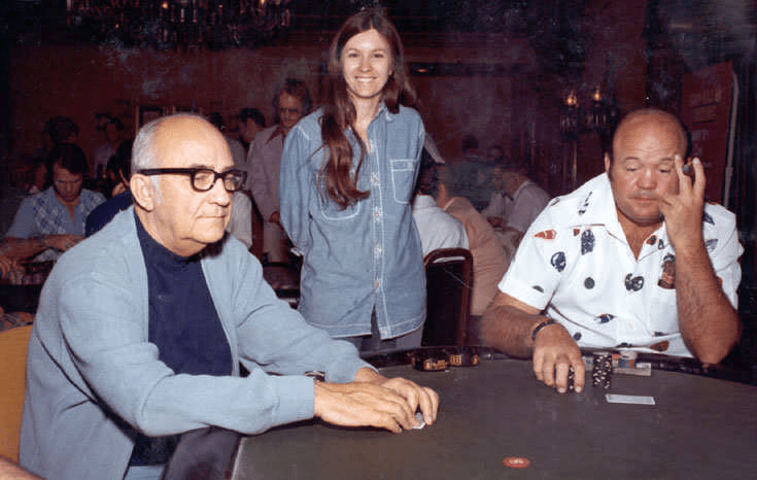
Image via worldpokerfederation.org under Creative Commons license.