In every poker game, behind each bet and every gesture lies a psychological battle that defines great players: the ability to read opponents. This concept, which combines observation, analysis, and strategy, is the ability to interpret the actions, patterns, and behaviors of those at the table, anticipate their decisions, and maximize one’s own winnings. Understanding what reading opponents entails means delving into the essence of competitive poker, where information is power and every detail can make the difference between winning and losing a pot. For this reason, in the following article, we will explain the essence and purpose of reading opponents in poker.
The importance of information in poker
Poker is a game of incomplete information. Unlike other card games, players never have access to all the data: they don’t know their rivals’ cards and must make decisions based on probabilities and deductions. This is where reading opponents comes into play, allowing players to transform seemingly insignificant signals into valuable clues. Observing how someone bets, how long they take, what expressions they show, or how they handle their chips can reveal the strength or weakness of their hand. In this sense, reading opponents is the bridge between the mathematics of the game and human psychology.
Reading betting patterns
One of the most relevant aspects of reading opponents is analyzing betting patterns. Each player develops, consciously or unconsciously, a style reflected in the way they place their chips. Some tend to bet “big” only with strong hands, while others use large bets as intimidation tools. Recognizing these patterns allows players to identify tendencies and adjust their strategy. For example, if a player always raises preflop with premium hands, detecting that regularity helps decide when to confront them and when to fold. The key lies in making multiple observations and building a profile for each rival.
Body language and “tells”
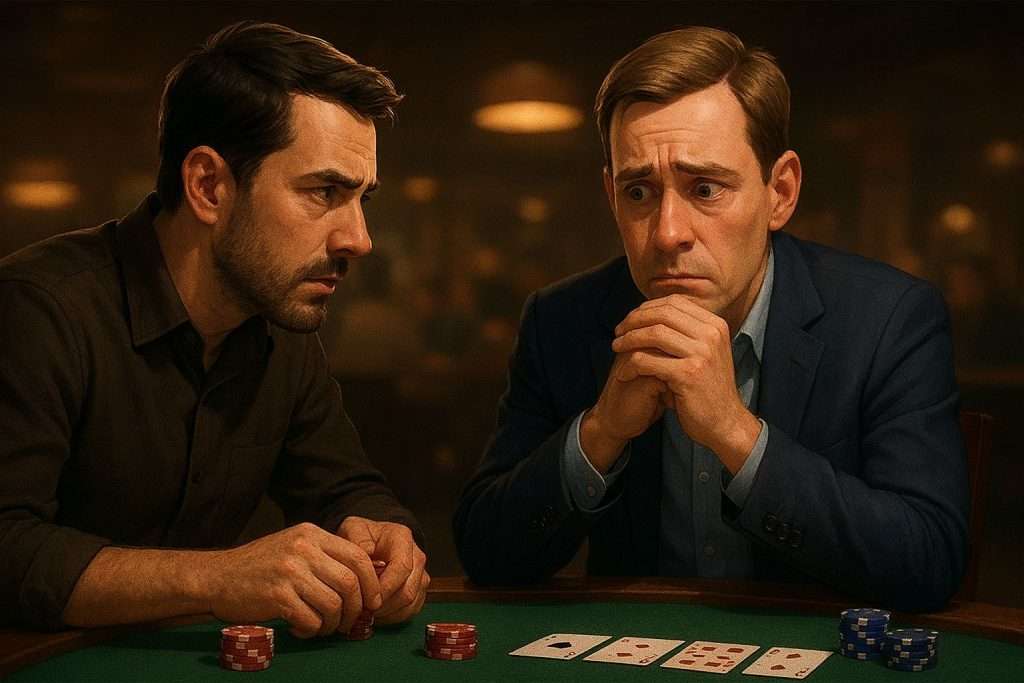
Beyond chips, body language reveals much about a player’s true intentions. In poker, “tells” are physical or behavioral signals that provide information about a player’s hand. These signals can be gestures, postures, changes in breathing, or even the way they look at their cards. A nervous player who moves excessively may be bluffing, while someone who remains still could have a strong hand. However, interpreting tells requires caution, as many experienced players fake behaviors to confuse their rivals. Therefore, reading opponents is not based on a single signal but on the accumulation of consistent patterns.
Time as an indicator
The time a player takes to make decisions is another source of information. A quick response may indicate confidence, while a prolonged pause may reflect doubt or calculation. Sometimes players act in the opposite way to deceive: they delay with a firm hand to simulate indecision, or respond quickly with a bluff to appear secure. Reading opponents involves recognizing these dynamics and contextualizing them within the rival’s overall style. Time, combined with betting and body language, becomes a powerful tool to decipher intentions.
Playing styles and psychological profiles
Every poker player develops a particular style that can be classified into general profiles: aggressive, passive, tight (selective), or loose (wide). The aggressive player seeks to dominate the table with constant bets, while the passive one limits themselves to reacting. The tight player carefully selects their hands, and the loose player participates in many rounds. Identifying an opponent’s psychological profile allows anticipation of their hand range and behavior in different situations. Reading opponents involves adjusting strategy based on these profiles, exploiting weaknesses, and avoiding strengths.
Reading in live poker vs. online poker
Reading opponents varies depending on the context. In live poker, physical tells and body language are fundamental. In contrast, in online poker, where there is no visual contact, reading focuses on betting patterns, reaction times, and game statistics. Online players develop digital habits that can be as revealing as gestures at a physical table. For example, someone who constantly folds to raises may be playing conservatively. Adapting to the environment is essential for compelling opponent reading.
At physical tables, the field of information is vast and sensory, since players have access to the entirety of body language: eyes (dilated pupils can be hard to control), energy levels, micro-expressions, among others. However, the pace of play tends to be slow, and the number of hands per hour is low, so building a profile based on action patterns can take time. It is essential to highlight that in physical tables, there is the “noise” factor—gestures that mean nothing. Therefore, the key in live games is selectivity: not trying to analyze every tic of every player, but focusing on a few key points, especially those in positions of greater interaction, seeking apparent deviations that contrast physical information with observed decision-making.
In virtual tables, the physical world disappears, as there are no faces, hands, or voices (unless audio rooms are used). Reading shifts almost exclusively to action patterns and statistical analysis. The speed of play (multitabling) and the availability of massive data (HUDs—Heads-Up Displays) change everything. A HUD shows real-time statistics about each opponent: percentage of hands played, percentage of raises, 3-bet frequency, post-flop aggression, etc. These metrics are the quantified baseline. Reading here is cold, mathematical, and based on large numbers. The psychological factor manifests in timing tells (how long they take to act) and deviations from their established statistics.
Bluffing and counter-reading
Bluffing is one of poker’s most potent weapons, and its success depends on the ability to manipulate rivals’ perceptions. Reading an opponent also involves detecting when they are trying to deceive. Counter-reading consists of identifying false signals and distinguishing them from genuine ones. An experienced player may simulate nervousness to induce an error in their rivals; therefore, reading opponents requires a balance between confidence in observations and skepticism toward possible psychological traps. Bluffing and counter-reading are part of a mirror game, where the mind is as important as the cards.
The psychology behind reading
Reading opponents is not only technical but also psychological, as it involves understanding how emotions influence decisions. Fear, greed, frustration, or euphoria can alter a player’s behavior, making them more predictable. Recognizing when someone is on “tilt” (out of emotional control) allows exploitation of their vulnerability. Psychology applied to poker turns the table into a stage where each player battles not only with the cards but also with their own emotions and those of others.
Common mistakes in reading opponents
Many beginner players make inevitable mistakes when trying to read their rivals. The most frequent is relying too much on a single signal and making hasty decisions. Another mistake is projecting one’s own habits onto others, assuming everyone thinks the same way. Reading opponents requires patience, data accumulation, and objective analysis. Avoiding personal biases and keeping an open mind are fundamental to accurate, valid interpretations.
What do you think about this topic? Would you like to know more about reading opponents in poker?
If you want to find the best poker deals online, you can contact us by visiting the following link.