Professional poker, often dominated by men and intimidating for women, has seen pioneers whose influence endures. Barbara Enright stands as a legend—a woman who not only competed with the best but also reshaped poker history. While many see poker as luck or a pastime, Enright made it her vocation, defying expectations and building a nearly untouchable legacy. In this article, we take a closer look at player Barbara Enright.
The origins of a legend
Barbara Enright was born in Los Angeles, California. Her first contact with cards came at an incredibly early age, at just 4 years old, when she played poker at home against her older brother. What began as a childhood game would become the passion of her life. However, the path was neither direct nor easy. Long before shining under the lights of the Rio All-Suite Hotel & Casino, Enright led a life of conventional jobs. She obtained a cosmetology license and worked as a Hollywood hairstylist, attending to famous clients; she was also a bartender and a waitress.
During those years, Enright often had to support her family, at one point holding three jobs simultaneously to make ends meet. It was in the mid-1970s, specifically 1976, when she began playing poker in the card rooms of Gardena, California, for extra income. She soon realized that her earnings at the tables far exceeded the combined effort of all her other jobs. It was then that she made the brave decision to leave her formal employment and become a professional poker player.
The leap to professionalism and global recognition
In the late 1970s and early 1980s, the poker ecosystem was radically different from today’s. Women were often relegated to specific tournaments or secondary roles. However, Enright decided to compete on equal footing in “Open” events, facing off against the legends of the old guard. Her rise was meteoric—not due to luck, but to statistical consistency that soon caught the attention of the international community. Her approach was aggressive when the board required it and extremely cautious when the odds were not in her favor—a duality that caught players accustomed to a more linear and predictable style of play off guard.
The year 1986 marked a definitive turning point in her career. By winning her first World Series of Poker (WSOP) bracelet in the Women’s tournament, Barbara validated her status, but she didn’t stop there. Her ambition drove her to seek respect in “Open” tournaments, where the difficulty level and the aggressiveness of betting were significantly higher. For Enright, gender was an irrelevant variable compared to the game’s mathematics and psychology. This mindset enabled her to navigate complex tournament structures and survive high-pressure prize bubbles, solidifying her reputation as an elite competitor unafraid of the most imposing figures on the circuit.
The feat of 1995
If there is one moment that defines Barbara Enright’s career and appears in every poker history book, it is her participation in the 1995 WSOP Main Event. In a field full of the best players in the world, Barbara achieved what no woman had done before and has not repeated since: reaching the final table of the most important tournament on the planet. Finishing in fifth place was not just a personal or financial achievement; it was a statement of principles for the entire industry. Her performance proved that poker talent knows no gender and that high-level strategy is universal.
This fifth-place finish is remembered with a mix of admiration and a touch of “what if,” as an unfortunate hand against Dan Harrington deprived her of advancing further. However, the impact was already made. Broadcasts of the era and journalistic chronicles highlighted her nerves of steel under the pressure of the cameras and millions of dollars at stake. Enright became an involuntary ambassador, inspiring a new generation of women—such as Annie Duke, Vanessa Selbst, or Vanessa Rousso—to enter professional poker with the certainty that the glass ceiling had already been cracked.
The Hall of Fame
Barbara Enright’s greatness is not limited to her performances at the World Series. Throughout her career, she has accumulated more than 25 victories in other renowned tournaments, demonstrating enviable versatility and consistency. Enright is one of the few people in the world to hold bracelets across different modalities, showcasing her technical range. She did not limit herself to Texas Hold’em; she mastered variants like Seven Card Stud, showing a deep understanding of game mechanics beyond the two community cards. Her ability to adapt to different rhythms and rules kept her relevant for decades—a near-Herculean achievement in a discipline where trends and strategies change constantly.
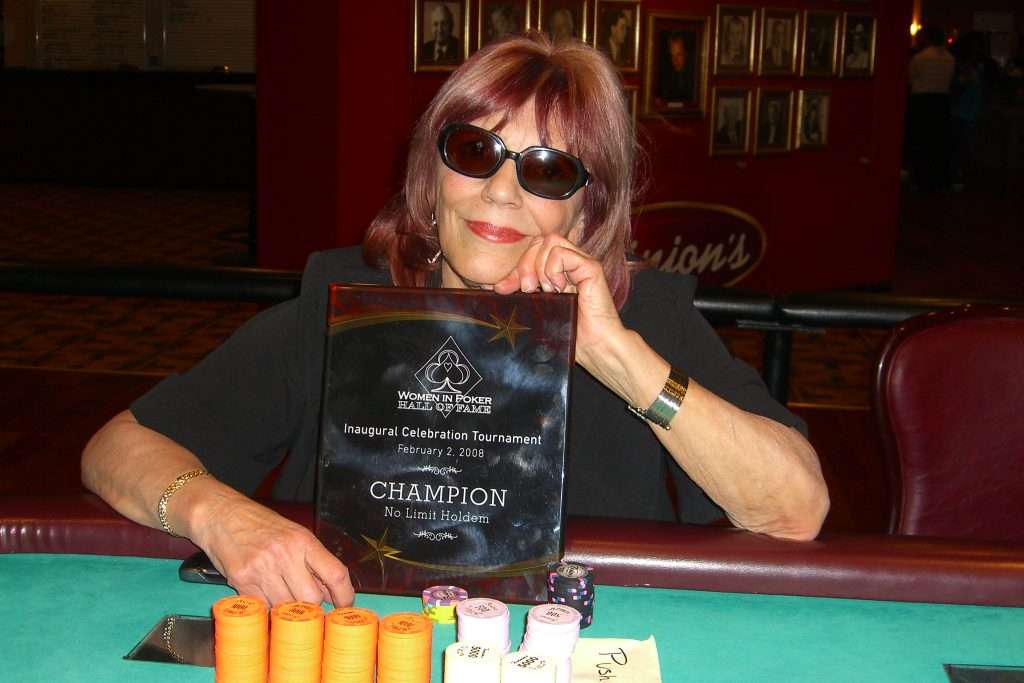
In 2007, Barbara Enright received the highest possible honor: she was the first woman inducted into the Poker Hall of Fame. This recognition was not just for her accumulated earnings or titles, but also for her contribution to the game’s growth and legitimacy. By joining this select group, she sat alongside names like Doyle Brunson and Chip Reese, solidifying her place in the Olympus of cards. Her induction was an act of historical justice that recognized years of fighting against stigma and underestimation, proving that her seat at the table was more than earned on her own merits.
Playing style
Analyzing Barbara Enright’s style means delving into the old-school “tells” and emotional management. While modern players rely heavily on GTO (Game Theory Optimal), Enright has always trusted her refined instinct. She understands poker as a constant conversation between egos, where the one who best controls their narrative takes the pot. Her game is characterized by infinite patience, waiting for the exact moment to strike, but also by an unusual courage to bluff in high-risk situations if she detects weakness in her opponent.
The living legacy of the “First Lady of Poker”
Beyond her role as a player, Enright has been a prolific editor and writer for specialized magazines such as Woman Poker Player. In addition, her educational work has been fundamental in demystifying the game and making it accessible. She has always advocated responsible, strategic poker, moving away from the image of the game as pure chance. For her, the poker table is a microcosm of life: it requires preparation, resilience in the face of defeat, and the humility necessary to keep learning, no matter how many bracelets adorn your wrist.
Today, Barbara Enright remains an active and respected figure. Her presence at tournaments generates an immediate aura of respect among veterans and curiosity among young players who only know her from archive videos. Her longevity on the professional circuit is a case study on how to maintain mental sharpness and passion for a game that can be exhausting. She not only survived the era of “road gambling” but flourished in the digital age, adapting to new dynamics without losing her essence.
What do you think about this topic? Do you want to know more about Barbara Enright?
If you want to find the best platform to play poker online, visit the following link to contact us.
Image by Max Shapiro via Wikimedia.com under Creative Commons license.