Although poker and chess appear radically different, with one relying on hidden cards and the other on visible pieces, both games display notable similarities. They are demanding mental disciplines that require focus, strategy, and keen opponent analysis.
Despite being played in distinct settings, both games exemplify a strategic mindset, demanding vision, calculation, intuition, and emotional control. Top players in each field embody the same core idea: gaining an edge through deep strategic thought. These parallels have inspired many poker players to explore chess and vice versa. This article explores the fundamental similarities between poker and chess, highlighting how these seemingly opposite games connect at their core.
Long-term strategy
Success in both poker and chess depends on forming long-term plans, foreseeing moves, and adapting to changing dynamics. In chess, this appears in managing pawn structures, controlling the center, and building attacks over multiple stages. In poker, it means crafting a table image, manipulating perceived ranges, and creating conditions to extract maximum value in future hands.
The difference in these disciplines lies in visibility: while in chess everything is “on the table,” in poker, you play with incomplete information. However, in both cases, the ability to think in terms of sequences, patterns, and future consequences is what separates average players from advanced players.
Psychology and behavior patterns
One of the most valued skills in both games is reading your opponent. In chess, this manifests itself in the interpretation of moves that reveal intentions, whether it is the sacrifice of a piece that may indicate a hidden tactic or a seemingly passive move that conceals a trap. In poker, reading is even more complex, as it involves analyzing body language, betting patterns, decision-making times, and emotional reactions.
Both games require a keen sensitivity to detect patterns and deviations. A chess player may notice that their opponent avoids certain theoretical lines, which may indicate a level of insecurity or inadequate preparation. On the other hand, a poker player may identify that their opponent only “bets” when they have a strong hand, revealing a predictable strategy. In both cases, the ability to read between the lines and adjust the game accordingly to the situation is essential for good performance at the table.
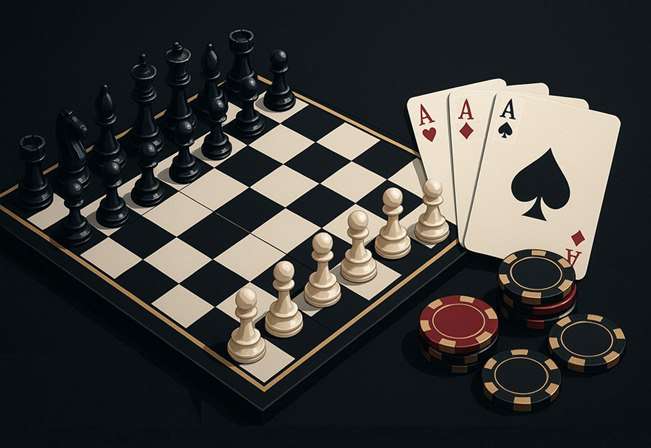
Risk management
Chess is a game of complete information, while poker is a game of partial information, yet both disciplines require precise risk management. In chess, this translates into evaluating sacrifices, calculating variations, and deciding whether it is worth entering into an uncertain tactical line. In poker, risk is present in every decision, for example, is it worth paying a bet with a certain hand project? Is it profitable to bluff in this situation?
In chess, although all the information is visible, the challenge lies in interpreting it, as a player must process an overwhelming amount of data: the position of each piece, the squares controlled, weaknesses, possible tactics, and the opponent’s plans. “Perfect information” is an illusion, because the opponent’s thoughts and intentions are a complete mystery. The chess player must infer their opponent’s plan based on their moves, just as a detective searches for and “connects clues” to build a strategy that allows them to advance their investigation.
Decision-making in both games is based on the evaluation of probabilities, although in chess these decisions are more deterministic, while in poker they are more statistical. A chess player calculates specific variations; a poker player estimates ranges and percentages. However, in both cases, the player must make decisions under pressure with limited information and accept the consequences of their choices.
Emotional control
Managing emotions is another shared trait between poker and chess. Both games test composure—a brilliant move can be undone by a small error, and a winning hand can turn with an unexpected card. In chess, tilt shows as rash moves after losing material; in poker, tilt leads to reckless bets after setbacks. Successful players cultivate mental resilience, learn from mistakes, and stick to their plan regardless of frustration. Mental discipline not only elevates performance but also prolongs a player’s career. In both, the mind acts as both a tool and a battleground.
Theory, practice, and continuous improvement
Both poker and chess demand ongoing dedication to learning and self-improvement. In chess, this means studying openings, analyzing classic games, solving tactics, refining endgames, and reviewing personal games. Poker involves hand analysis, range study, statistical review, and strategic discussions.
It is important to note that both games have evolved with technology. For example, in chess, exercise applications, engines such as Stockfish, and game databases are used, while in poker, tools such as solvers, trackers, and simulators are used. The players who remain at the top are those who understand that knowledge is dynamic and who combine talent with constant work.
Professional poker players who play chess
There are many professional players who play chess as part of their training or daily routine, as this practice allows them to gain a greater perspective, improve their strategic thinking, and enhance their problem-solving skills. For example, as we saw in our previous article, Daniel Negranu plays chess every day while eating breakfast, which has become an important part of his morning routine.
What do you think about this topic? Do you know of other professional players who play chess as part of their daily routine?
If you’re looking for the best poker deals, feel free to contact us by visiting the following link.