Positions in poker are crucial, as they determine the amount of information you have about your opponents’ hands before you act. Starting or early positions are those in which you act first after the cards have been dealt and the blinds have been made. This plays a crucial role in-game strategy.
Knowing what starting positions are
Starting positions, also known as “under the gun” (UTG), are the most challenging in terms of strategy. They are classified as UTG (Under The Gun), the first player to act after the blind positions. It is the earliest position and, therefore, the most unfavorable. UTG+1 is the second player to act, and UTG+2 is the third player to act (if there are more than 9 players at the table).
The main disadvantage of starting positions is that players must act without information about the actions of the other players, which can limit their options and strategies.
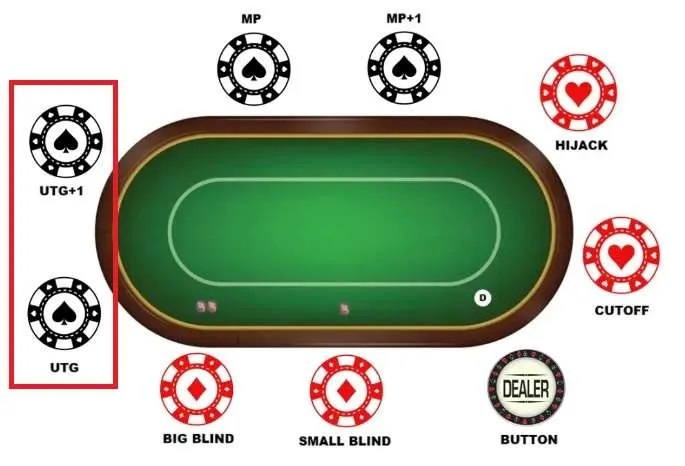
Starting positions and their relevance
One of the most critical aspects of these positions is that you have less information. By acting first, you have no information about your opponents’ cards. This means you must play a narrower and more substantial range of hands to avoid exploitation. By acting first, you pressure the players behind you because, if you bet, the other players may feel obliged to respond, even with weaker hands.
These positions have less flexibility because a lack of information limits the game. You cannot adapt your strategy to the actions of your opponents in the same way as you would in later positions.

Strategy in early positions
The key to playing from early positions is caution and careful hand selection. One of the main strategies recommended is to play strong hands, such as high pairs (AA, KK, QQ) or aces with good kickers (AK, AQ), and some speculative hands, such as high-suited connectors (AKs, AQs), and avoid marginal hands such as small pairs (22-66) and low connectors (76s, 65s), which should be played with great caution, as they are less likely to improve and can lead to difficult situations.
It is advisable to make substantial bets to reduce the number of opponents and increase the odds of winning the pot. A standard raise from UTG is usually 2.5 to 3 times the big blind (BB). This helps reduce the number of opponents and protects the hand.
It is also recommended that we fold if we face strong resistance from our opponents. If we receive multiple re-raises, we will likely face strong hands and should consider folding. Being conservative in early positions can save us a lot of chips in the long run.
The UTG+1 and UTG+2 positions are not as challenging as the UTG position but still require careful strategy. The recommendations are similar to UTG, but you can afford to be slightly more flexible with hand selection and bet sizing.
Factors to consider
In addition to hand selection and bet sizing, there are other factors to consider when playing from early positions. If you have been playing aggressively, your opponents may expect you to play strong hands from early positions, so knowing the image you convey at the table is essential. Your opponents’ aggressiveness and playing style also influence your strategy, so you should adapt your game according to the dynamics of the table and the size of your stacks. With a short stack, you should play conservatively and look for opportunities to double up.
Playing from early positions at a poker table can be challenging, but with careful strategy and discipline, you can minimize your risk and maximize your profits. By mastering the game from early positions, you will be better prepared to face any situation at the poker table.
What do you think about this topic? Do you want to know more about poker table positions?
To find the best poker deals, visit the following link to contact us.