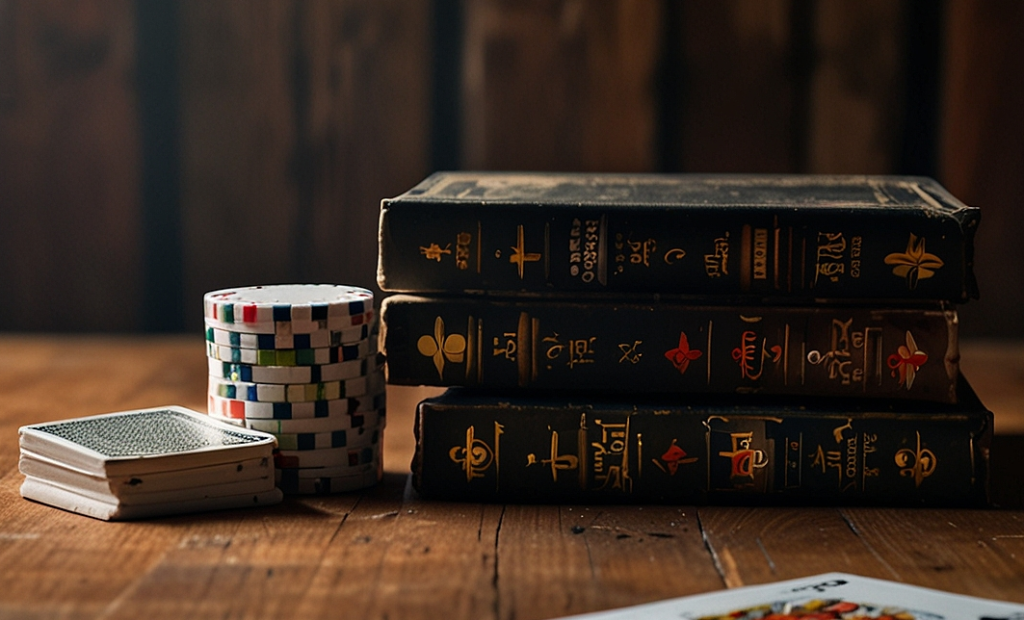
Poker goes beyond being just a game of skill. It has managed to influence popular culture, especially by becoming the central theme of several books. It serves as a metaphor to address some deep and complex issues and show relevant aspects of human nature. Poker’s ability to arouse emotions and challenge the participants makes it a very useful literary resource. Below, we share some literary works that were influenced by poker.
The Gambler (1866) by Fyodor Dostoevsky
In this novel, which resembles much of Dostoevsky’s own life, we follow the story of Aleksei Ivanovich, a tutor who loses his head over a young girl named Polina and ends up completely immersed and trapped in the world of roulette and poker.
Dostoevsky, through Alekséi, makes us feel firsthand what it is like to be consumed by obsession and despair, that constant internal struggle between good and evil. The game’s intensity perfectly reflects the emotional storm that Alekséi lives through, showing how the risk and reward of poker can drive anyone crazy. In addition, the novel gives us an evident vision of the Russian society of that time and its relationship with gambling.
The Mysterious Stranger (1916) by Mark Twain
Although this novel does not focus directly on poker, Twain uses the game to delve into morality and human nature. In Twain’s hands, poker becomes a mirror of society. The decisions and strategies of the players reveal their true intentions and ways of thinking. Twain succeeds in showing that, through poker, people’s deceptive and competitive nature is uncovered. It is as if the card game is a window into our deepest selves, revealing what we are when we think no one is watching.
The Outcasts of Poker Flat (1869) by Bret Harte
This story follows a group of individuals who, after being driven out of their community, find shelter in a camp during a snowstorm. Poker symbolizes their marginalized lives and the decisions that led them to their current situation. Bret Harte uses gambling to explore themes of redemption and morality, showing how the characters demonstrate humanity and sacrifice in extreme circumstances despite their messy and chaotic lives.
Casino Royale (1953) by Ian Fleming
In the first James Bond novel, “Casino Royale,” Agent 007 confronts Le Chiffre in a baccarat game. Ian Fleming uses the card game to create tension and develop Bond’s character, highlighting his cunning and ability to read his opponents. The game of baccarat is the novel’s climax, representing a battle of wits and will between hero and villain.
Positively Fifth Street: Assassins, Cheetahs, and the Binion WOSP (2004) by James McManus.
The author (McManus) combines journalistic chronicle and personal narrative in his 2000 World Series of Poker (WOSP) account. While covering the event for Harper’s Magazine, the author decides to participate in the tournament. Through his experience, James McManus explores ambition, luck, and the fine line between fact and fiction in professional poker. He offers an intimate view of the poker underworld, showing its glories and perils.
The Biggest Game in Town (1983) by Al Alvarez
This book is considered a seminal text on poker in Las Vegas. The author recounts his observations of the 1981 World Series of Poker (WOSP), providing vivid descriptions of the players and the tournament atmosphere. It is not only a chronicle of the event but also reflects on the nature of the game and its emotional and psychological impact on the participants, using poker as a metaphor for the uncertainties and decisions in life.
What do you think about this topic, and do you know of other noteworthy literary works related to poker?
If you want to find the best platform to play poker online, visit the following link to contact us.