The position at the table plays a fundamental role in poker since it can increase or decrease the chances of winning a game. The leading positions in poker are divided into blinds or early, middle, and late positions.
Late positions
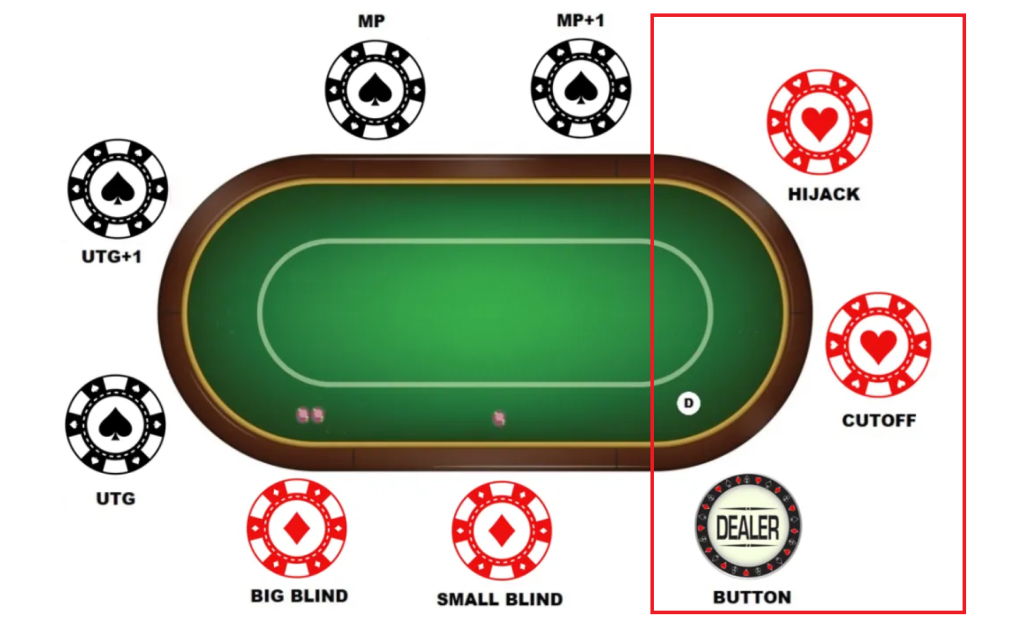
Among the main late positions is the “HiJack,” which is two seats to the right of the dealer’s button. Then there is the “Cutoff,” which is the player who acts immediately before the dealer. Finally, there is the dealer’s “Button,” who acts last in each betting round.
Having the advantage of acting later
When we play in late positions, we play “in position” (IP), meaning we can see what the others have done before making a decision. Seeing what the other players have done “before” our turn comes gives us more clues to make better decisions.
Let’s imagine that we are in a hand and several players have already acted: some have passed and others have bet weakly. This information will help us read the game better: are they protecting themselves or waiting for a card to arrive? Suppose a player has only checked or bet low. In that case, we can deduce that his hand is weak and take advantage of that situation. Having this data gives us a huge advantage since, in poker, acting with more information always puts us ahead of our opponents.
Play more hands
We have to be more careful in early positions, but we can open with a broader range of hands in late positions. This is because we already know how many players are still in the hand and because, in general, the probability that someone has a firm hand is lower. Even hands like low connectors or small pairs can be played with more confidence.
Putting pressure on others
When we are in a late position, we can be more aggressive. If we see others playing fearfully or passively, it is the ideal time to make a strong bet and pressure them. Most players will not want to risk it and will then end up folding, allowing us to take the pot unopposed.
Stealing pots
One of the best moves from the button or the cutoff is to steal pots by taking advantage of our opponents’ passivity. If the other players have shown weakness, an aggressive raise can make everyone fold, especially if only the blinds are left to act.
Strategies to use
In late positions, our play can become more flexible. For example, we can try some plays that, in early positions, we would not dare to make:
- Increase the range of hands: In late positions, we can be more aggressive and open with hands that we would not normally play. The risk is lower, and if we connect on the flop, we will be in a privileged position to continue putting in chips. Speculative hands can become real “jewels” if we know how to play them well.
- Continuation bets: If we raise the pre-flop from a late position and our opponents only pay, a continuation bet on the flop (even if we don’t connect) can make them fold. Having shown “strength” early on, our opponents may not want to continue taking risks with a weak hand.
- Control the pot: We don’t always have to be aggressive. Sometimes, when the flop does not favor us, and we do not have a strong hand, it is best to control the size of the pot. Being in a late position, we can decide whether to continue betting or make a small bet to not inflate the pot but to avoid exposing ourselves to unnecessary risks.
Things to keep in mind in late positions
Despite all the advantages, playing in late positions can also lead to common mistakes. It is easy to be tempted to open with too many marginal hands just because we have that privileged position. Doing this constantly can get us into difficult situations, especially if we face players who know how to counter these strategies.
If our opponents notice that we always play the same way from the button or cutoff, they will adjust their play to exploit our deficiencies. This is common in poker rooms or tables with more experienced players, who tend to be aware of certain patterns of play of other players and look for any weakness to be exploited.
The true power of position
Playing from late positions offers us a clear advantage: more information than the rest of the players. If we manage to master this aspect of the game, we can maximize our profits, reduce risks, and take control of the table. All this makes the difference between an average player and an advanced player who knows what he is doing.
Playing in late positions is not only about having more hand options but also about knowing when to push, when to fold, and, above all, taking advantage of the other players’ passivity to take the pot without going to a showdown. The key is to use the information to our advantage and adapt to each situation.
What do you think about this topic? Do you want to know more about poker positions?
If you want to find the best platform to play poker online, visit the following link to contact us.