Every great disruption in the gambling industry begins with a crack in the user experience. In the case of BasePoker, the spark didn’t ignite in a corporate boardroom, but rather from a player’s personal exasperation. In this article, we will delve into the creation of BasePoker, a platform born with the ambition to become the “PokerStars of browsers,” with a crypto soul.
The need for evolution
The story of BasePoker doesn’t start with lines of code, but with a shared frustration at traditional gaming tables and first-generation digital platforms. In the early 2010s, the online poker ecosystem faced an identity crisis. Players felt alienated by opaque algorithms, cluttered interfaces, and a growing disconnect between the “house” and the user. In this context, a group of tech enthusiasts and professional players began to conceive what we now know as BasePoker. The premise was simple yet ambitious: to create an environment where transparency wasn’t an option, but the foundation of every hand dealt.
The founding team understood that poker is not just a card game, but a discipline of risk management and psychological reading. Therefore, they spent months analyzing where competitors were failing. They discovered that the biggest obstacle to user retention was a lack of trust in the Random Number Generator (RNG). The creation of BasePoker initially focused on solving this technical dilemma by developing real-time auditing methods that would allow players to verify the game’s integrity without interrupting play.
Costa Rica
The official history of BasePoker begins in June 2024. Unlike many platforms operating in a legal gray area, BasePoker chose to establish itself under a gaming license obtained in Costa Rica, the country from which the parent company manages its operations. This move was intentional: they chose a jurisdiction that understands the online gaming business model, free of the protectionist hurdles of closed markets, while maintaining a clear regulatory framework.
Its launch wasn’t announced with fireworks on Wall Street, but through feedback in specialized forums. On platforms like Bitcointalk, early users received the news with equal parts skepticism and curiosity. From day one, the BasePoker team interacted with active forum users, accepted criticism regarding their post formats, and even launched exclusive promotions giving away USDT to members of the Bitcoin community. This “forum diplomacy” was crucial for their first 1,900 visits and for establishing their initial reputation.
Technical development
Once the vision was defined, the BasePoker development process entered a critical engineering phase. Unlike other platforms that purchased third-party software, the founders decided to build their own engine from scratch. This allowed them to optimize latency, a crucial factor for high-volume players operating on multiple tables simultaneously. During this period, the development office became a testing laboratory, simulating millions of hands per hour to ensure the system could scale without losing stability.
The name “Base” was not chosen by chance; it reflected the intention to serve as the fundamental structure upon which a new poker economy would be built. Banking-grade security protocols were implemented, and a User Interface (UI) was designed to eliminate unnecessary visual distractions, focusing on ergonomics and decision-making speed. This minimalist yet powerful approach became the hallmark of the software in its alpha versions.
Conquering the niche
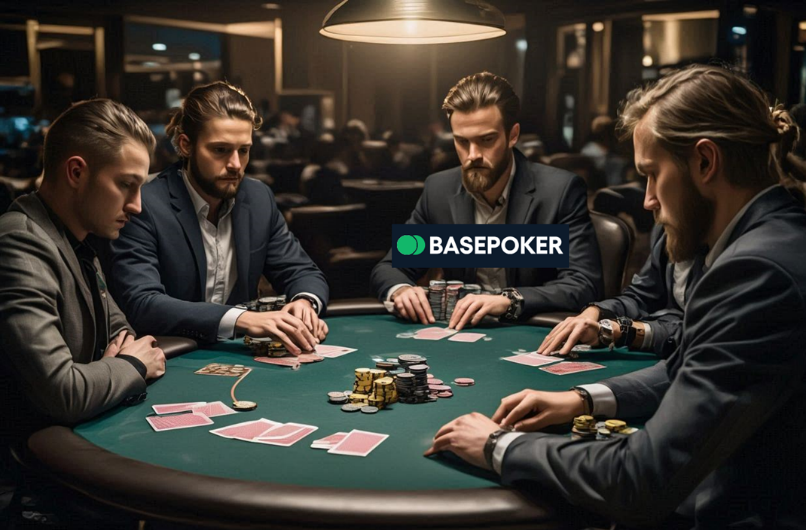
When BasePoker finally opened its doors in beta, it didn’t seek to compete with industry giants through astronomical marketing budgets. Instead, they opted for organic, community-based growth. They approached specialized forums and poker study groups, offering a platform that actively listened to user feedback. This “by players, for players” strategy allowed the first tables to fill with high-knowledge users, raising the platform’s prestige from its earliest months.
Word of mouth was the primary engine of its expansion. Players appreciated the speed of withdrawals and the clarity of bonus rules—areas where the industry was often deliberately confusing. BasePoker positioned itself as a sanctuary for those seeking fair play and a vibrant community. During this stage, the first flagship tournaments were introduced, featuring more horizontal prize structures to encourage participation from recreational players without neglecting professional players.
Constant innovation
As the platform grew, the BasePoker team realized that mobile technology was transforming gambling consumption. Having a good desktop client wasn’t enough; they needed a mobile experience that didn’t sacrifice strategic depth. Moving to a hybrid architecture allowed users to seamlessly switch from their computer to their smartphone, maintaining the same fluidity and security. This adaptability was key to surviving in an increasingly competitive and regulated market.
Beyond technical infrastructure, BasePoker innovated in the game’s social aspect. They introduced private club features and integrated analytical tools that allowed players to review their own statistics pedagogically. This transformed BasePoker from a simple betting site into a training and socialization tool. Creating an educational ecosystem around the platform helped demystify poker and attract a new generation of users interested in the game’s strategic component.
Furthermore, the team designed a radical privacy policy. Unlike traditional rooms that require ID or a passport upon registration, BasePoker allows completely anonymous play with just an email address or a MetaMask wallet. Know Your Customer (KYC) is triggered only when a player exceeds $10,000 in cumulative withdrawals. This product decision, made during the design phase, reflects a deep understanding of crypto ethics: personal sovereignty first, regulation second.
Rake, rewards, and the role of the host
A standout chapter in the creation of BasePoker was the reinvention of the “host” role. Historically, organizing a private game was a favor done for friends. BasePoker saw a business and gamification opportunity. Any user can create their own table, customize the blinds, and, most importantly, collect their own rake.
This functionality, documented since the first support articles, transformed players into entrepreneurs. If you had a following or a group of friends, you could monetize your own influence. This feature, though simple in code, was revolutionary in concept, as it democratized rake revenue, which was traditionally an exclusive monopoly of the house.
In parallel, the room introduced innovations in user retention. The famous “freerolls” became a staple. Since its inception, the platform knew that to attract the Bitcointalk user—known for being an opportunity hunter—it needed free tournaments with real prizes. Thus, they institutionalized four daily free tournaments, creating a constant flow of players that filled the lobby and brought the cash tables to life.
The future
The creation of BasePoker is a case study on how user frustration can translate into a unique value proposition. In less than two years, it went from being an idea in the mind of someone tired of downloading software to a platform processing transactions across multiple blockchains and hosting NL1000 tables.
Its legacy, still under construction, is not just that of a poker room, but of a paradigm shift. It proved that to be “online” you don’t need a desktop client; to be “crypto” you don’t have to use Bitcoin as a mere bridge; and to be profitable, you don’t need to “squeeze” the player with rake.
What do you think about this topic? Do you want to know more about BasePoker?
If you want to learn more about BasePoker, you can visit our BasePoker review at the following link.