Poker is a cultural phenomenon that has captivated millions of people worldwide, combining strategy, psychology, and an unmistakable spirit of competition. Although many associate it with the American Wild West or the skyscrapers of Las Vegas, its origin is a complex story that spans continents and centuries, as poker has roots in several cultures: Persia with As Nas, France with Poque, England with Brag, and even Chinese influences.
Poker became consolidated in the United States in the 19th century, eventually becoming a global, digital phenomenon. In this article, we will learn more about the origin of poker and how it evolved into the worldwide phenomenon we know today.
The uncertain origins of poker
Talking about the history of poker means entering a territory full of theories, traditions, and legends. There is no absolute consensus on its birth, but multiple clues allow us to reconstruct its evolution. Poker did not emerge out of nowhere, but rather as a fusion of various card games played across cultures and eras.
Some historians suggest its roots may be found in China around 900 A.D., in a domino-like game that involved betting. Others point to Persia, where, in the 16th century, As Nas was played, a game with 25 cards and betting rounds that closely resembles modern poker. France also contributed to Poque, a 17th-century game that introduced the concepts of bluffing and strategic combinations. England, for its part, offered Brag, an 18th-century game that also used betting and deception as essential parts of its dynamic.
The leap to America: New Orleans and the Mississippi River
Poker, as we know it, began to take shape in the United States in the early 19th century. French settlers brought Poque to New Orleans, where it quickly became popular in taverns and on boats traveling along the Mississippi River. The first detailed description dates back to 1829, when English actor Joseph Cowell observed a game in New Orleans played with a 20-card deck and four participants. Shortly after, Jonathan H. Green documented in his 1843 book the rapid expansion of the game along the Mississippi River, carried by riverboats, where poker was the main pastime.
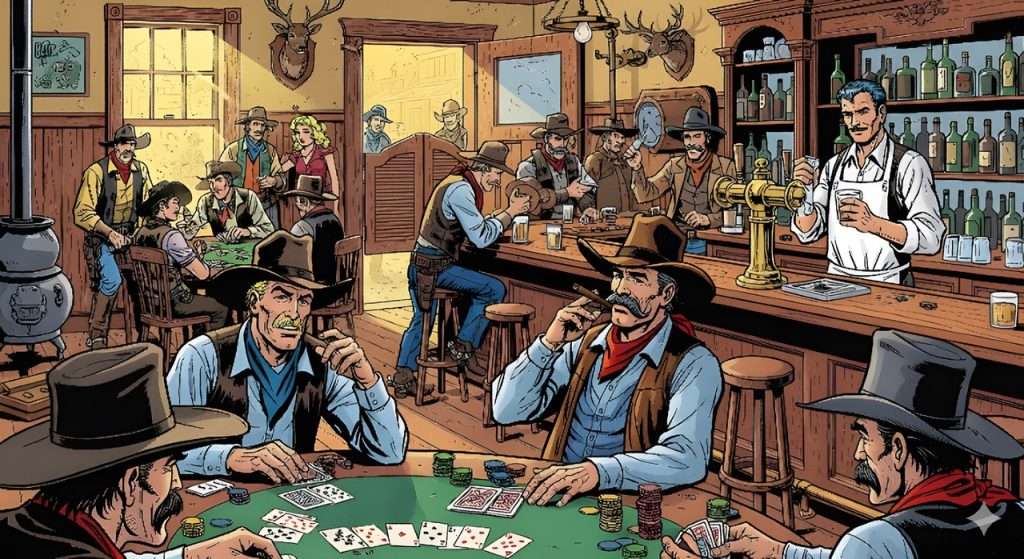
Soon, the whole French deck of 52 cards was adopted, allowing for more complex combinations such as the flush. This period also saw the birth of two legendary figures: the riverboat gambler, a skilled and often shady character traveling on steamboats, and the pioneer of the Wild West, who made poker a central element in frontier saloons during the Gold Rush. In saloons and mining camps, poker became an essential pastime, a symbol of risk, strategy, and luck. Games were intense, with high stakes and an atmosphere charged with tension.
Poker in the Civil War and its arrival in Europe
During the American Civil War (1861–1865), poker spread even further. Soldiers from both sides played it in their free time, and upon returning to their communities, they carried it with them, consolidating its presence throughout the country.
This era of expansion was also a time of great innovation, as numerous variants were created and standardized that remain relevant today, such as Draw Poker, where players can discard and receive new cards to improve their hand; Stud Poker, which combines hidden and visible cards; Seven-Card Stud; and Straight Poker, which introduced the straight as a valid combination. By the late 19th and early 20th centuries, other innovations appeared, such as jokers (around 1875), lowball (where the lowest hand wins), and community card games, laying the foundation for Texas Hold’em.
In the second half of the 19th century, poker crossed the Atlantic. Queen Victoria showed interest in the game after learning its rules, thereby legitimizing its practice in Europe. From then on, poker ceased to be an exclusively American pastime and became an international phenomenon.
The 20th century: casinos and professionalization
The 20th century transformed poker from a parlor game into a structured discipline. A crucial milestone was the standardization of rules. Books such as the New Handbook of Games (1850) and successive editions of Hoyle established the basic rules that allowed fair and consistent play in different places. The second great revolution was the development of strategic theory. Until the mid-20th century, poker was considered mainly a game of intuition and bluffing. This changed with the publication of landmark works in the 1970s, such as Super System by Doyle Brunson and The Theory of Poker by David Sklansky, which analyzed the game from mathematical, psychological, and game theory perspectives.
With the expansion of casinos in Las Vegas and other cities, the game took on a more formal, competitive character. Organized tournaments emerged, and variants such as Texas Hold’em became the most popular worldwide. The creation of the World Series of Poker (WSOP) in 1970 was a turning point, as poker was recognized for the first time as a mind sport, with professional players achieving international fame. Poker ceased to be a tavern game and became a global spectacle. The following year, the main event was established as a No-Limit Texas Hold’em tournament with a $10,000 buy-in, a tradition that continues and crowns the world poker champion.
The digital era: online poker and globalization
Poker’s popularity experienced unprecedented growth in the early 21st century, driven by two technological innovations: the “hole-card camera,” a device that allowed television audiences to see players’ hidden cards, which transformed poker into a spectator sport; and programs such as the World Poker Tour and WSOP broadcasts on ESPN, which brought the drama, strategy, and tension of the game into millions of homes.
With the arrival of the internet in the 1990s, poker underwent a true revolution. Digital platforms allowed anyone to play from home against opponents worldwide. The first online poker game (for real money) was played in 1998 on Planet Poker. These platforms enabled anyone to play from home and participate in satellite tournaments for major events, and they also helped create a new generation of players. The iconic moment came in 2003, when Chris Moneymaker, an accountant from Tennessee who won his entry to the WSOP through an online satellite for $86, was crowned world champion. His story triggered the “Poker Boom,” a global explosion of interest in the game.
A game that never stops evolving
It is essential to highlight that poker has been recognized as a mind sport by the International Mind Sports Association since 2010, and its jargon (terms such as “poker face,” “bluff,” or “call a bluff”) has permeated everyday language in many languages.
Today, poker is a cultural and economic phenomenon. It is played in physical casinos, digital platforms, and mobile apps. International tournaments award millions of dollars in prizes, and their influence has been portrayed in movies, series, and literature, consolidating it as part of popular culture.
What do you think about this topic? Would you like to learn more about the history of poker?
If you want to find the Best Poker Deals, you can contact us by visiting the following link.
Image by Waffty Fugg via Pixabay.com under Creative Commons license.