The World Series of Poker (WSOP) is the most prestigious and important event in the industry and the largest set of poker tournaments globally. Since its birth in 1970, the WSOP has grown from a gathering of great players to a global phenomenon, marking iconic moments and turning prominent players into legends. With each edition, the cards on the table have shaped not only the history of the game but also popular culture.
From private games to international tournaments
The WSOP was born thanks to Benny Binion, a gambler and entrepreneur with a great vision, who had the idea of gathering the best players in his Horseshoe casino in Las Vegas in 1970. But this was not a tournament as we know it today since, on that occasion, there were no eliminated players or final table: they simply played cash games, and at the end of the day, the participants themselves voted who was the best of all. By then, Johnny Moss was already a legend of the game and was crowned.
A year later, the event was transformed with the freezeout format, the classic “Who runs out of chips, leaves.” Players no longer just wanted to participate; they wanted to win. The concept of the “champion” began to take shape, and in 1976 came the famous gold bracelets, the symbol that represents the pinnacle of any poker player’s career.
The Era of Legends: Doyle, Slim and Ungar
During the 1970s and 1980s, the WSOP was dominated by players who became true legends. Doyle Brunson, for example, won two consecutive Main Events with the same winning hand: a ten-two that has since been immortalized as the “Brunson hand.”
For his part, Amarillo Slim became the face of poker for the general public, mainly thanks to his charismatic style and his ability to attract cameras and media attention. But if there is someone who left an unforgettable mark, it was Stu Ungar. Better known as “The Kid,” he won the Main Events of 1980 and 1981. His ability to read opponents and calculate odds was on another level; however, he had many problems on a personal level.
An epic moment of this era was Jack “Treetop” Strauss’s victory in 1982. The reason? He was down to a single chip at one point in the tournament, yet he still managed to win the Main Event. From there was born the mythical phrase, “All you need is a chip and a chair,” which defines the essence of poker like no other: as long as there is something to play with, the game is still on.
Hellmuth, Chan and the rise of televised poker
Throughout the 1980s and 1990s, the tournament continued to grow in popularity. In 1989, 24-year-old Phil Hellmuth surprised everyone by defeating Johnny Chan (winner in 1987 and 1988) at the Main Event’s final table, becoming the youngest champion in history. His 1988 victory was so iconic that it was immortalized in the movie Rounders.
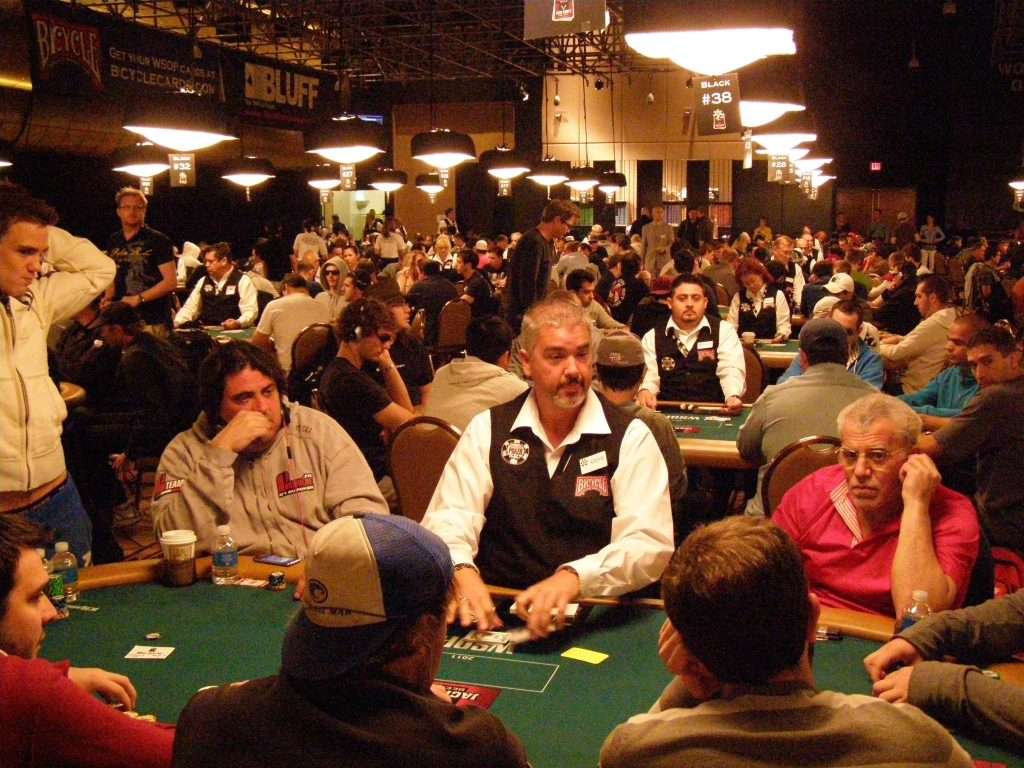
This was when television came into play, with ESPN taking the lead in broadcasting the tournaments. It wasn’t just about showing the moves; people wanted to see the emotions and the players’ faces and feel the tension in every hand. The magic of televised poker brought the game to millions of people. Suddenly, poker stopped being a “niche” game and became an accessible and exciting spectacle for the general public.
The Poker Boom
In 2003, they forever changed the history of the WSOP and poker. That year, a player named Chris Moneymaker qualified for the Main Event through a $39 online satellite. Against all odds, Moneymaker defeated professional players and was crowned champion, taking home a million-dollar prize.
Moneymaker’s victory was a message to the world: anyone can win, even if you’re not a lifelong pro. His victory sparked what we know today as the “poker boom”. Thousands of new players began participating in live and online tournaments, hoping to replicate his feat. This way, Texas Hold’em became the most popular modality worldwide, and the WSOP grew exponentially in participants and prizes.
Global Expansion and New Modes
The success of the Main Event pushed the organizers to expand the WSOP beyond Las Vegas. In 2007, the World Series of Poker Europe (WSOPE) was born, bringing the tournament’s prestige to the other side of the Atlantic.
With the rise of digital platforms, online tournaments began to be organized, allowing players worldwide to compete for a bracelet without leaving home. Another important innovation was the creation of special events such as the Big One for One Drop, a tournament with a buy-in of one million dollars. The objective was not only to offer a massive prize but also to raise funds for charitable causes.
These new proposals kept the tournaments “fresh” and attracted both old pros and new generations of players.
The WSOP today
Today, the WSOP remains the most prestigious event in the poker world. With its $10,000 buy-in, the Main Event remains the most coveted title, and legends like Phil Hellmuth (who holds a record 16 bracelets) continue to compete at the tables. However, new players appear yearly to keep the competition alive, proving that poker is more alive than ever.
Technology has also transformed the way the WSOP is experienced. With live streaming and mobile apps, players can follow each hand in real-time, creating a global community of players and spectators. The combination of tradition and modernity keeps the WSOP at the forefront of the poker world.
What do you think about this topic? Do you want to know more about the World Series of Poker or WSOP?
If you want to find the best platform to play poker online, visit the following link to contact us.
Image by Joe Shoe via flickr.com under Creative Commons license.