Bluffing in poker refers to making a bet with a weak or worthless hand; its objective is to deceive the other players and make them believe that you have a strong hand, causing them to fold and win the pot without a good hand.
However, bluffing in poker is not just about cheating. It is a true art in which our opponents are made to believe that we have a completely different hand. Without the physical cues of live poker, such as facial expressions or gestures, online players rely on other referential actions, such as betting patterns, response times, and previous behaviors, before performing an action.
Types of bluffs
Among the main types of bluffs are the following:
Pure bluff
A pure bluff is made with a weak hand with little or no chance of winning unless everyone folds. This type of bluff requires the most skill and relies heavily on our ability to convince the other players that we have a strong hand.
Semi-bluff
The semi-bluff is made with a hand that has yet to be strong but can improve in future betting rounds. This gives us a double chance to win: make the opponents fold or improve our hand in the following cards.
If we are simulating sure hands, these must be consistent with our play and behavior. For example, if we are simulating a solid hand but play passively before, we could lose credibility, especially against more skilled or experienced players.
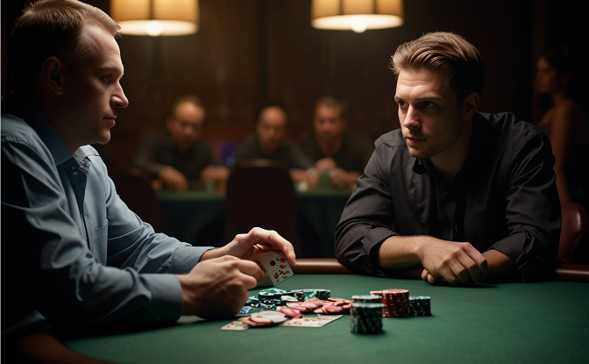
Points to consider when bluffing
Among the main points to take into account when bluffing are the following:
Reading the situation
Before bluffing, we must evaluate our opponents’ possible hands, their style of play, and our position at the table. It is important to note that bluffing from a late position is usually more effective due to the amount of information available.
Building a Story
Successful bluffing requires a coherent narrative that makes our “supposed” strong hand believable. This involves making consistent bets that reinforce the opponents’ perception of our hand. Consistency is key: if we represent a strong hand, our actions must support that story in all betting rounds.
Variation of play and type of players
We should not always act the same way. Varying our behavior is recommended to avoid opponents detecting patterns that may give away our bluffs. For example, changing the pace and size of the bets.
It is important to keep in mind that bluffing against a recreational or novice player is different from bluffing against a regular or advanced player. Recreational players are usually less “perceptive” to the consistent details of our game, while regular or expert players will require a more solid logic and construction behind our story.
It is important to identify the type of player we are playing against. For example, conservative players tend to fold to a bluff more than aggressive players.
Use of time
The time it takes to perform an action can influence our opponents’ perceptions. Fast actions may suggest confidence and strong hands, while slow actions may indicate deliberation, hesitation, or possible weakness.
Bluffing against fewer players
It is important to consider the statistics or probabilities of other players’ hands. It is safer and more effective to bluff against one or two opponents rather than against a full table, as the odds of someone having a strong hand are lower.
Evaluate the stack
Bluffing with an intermediate amount of chips (medium stack) can be more credible and less risky than bluffing with few or many chips. A medium stack shows that you are comfortable but not desperate.
Bluffing in online poker is a multifaceted technique that requires a deep understanding of the game’s dynamics and precise execution. It is not just a bluffing tactic but a comprehensive strategy that, when used correctly, can be decisive in winning significant pots.
What do you think about this topic? Do you want to know more about the art of bluffing in poker?
If you want to find the best platform to play poker online, visit the following link to contact us.